Quick answer by project type
For most home projects in Naperville, a 20 yard dumpster is the one to start with. It is our most popular size and handles kitchen and bathroom remodels, whole-home cleanouts, roofing and landscaping. Go 10 yard for a small remodel, a garage or single-room cleanout, or heavy material — concrete, tile, asphalt or roofing. Go 15 yard for a garage, attic or basement cleanout, flooring and carpet, a small deck or fence, or yard cleanup. Go 30 yard for a multi-room renovation, an estate cleanout or a retail or office remodel, and 40 yard for new construction, demolition, warehouse cleanouts and commercial roofing. Not sure? Call (630) 864-6143 and we size it for you.
The rule of thumb we use: 10 and 15 yards for small cleanups, roofing or heavy materials; a 20 for home renovations and landscaping; a 30 or 40 for large construction or demolition jobs.
The five sizes side by side
All five are open-top roll-offs about 7.5 feet wide. The 10 and 15 are shorter boxes; the 20, 30 and 40 share a 22-foot footprint and simply get taller. Trash bags are a rough guide to volume. The weight column is the allowance included in the flat rate.
Most people under-count the pile. When your estimate lands between two sizes, go up — a second haul costs more than the extra yards.
Check the weight, not just the volume
Volume and weight are two separate limits, and dense material hits the weight line long before the box looks full. Concrete, dirt, brick, tile and shingles are the usual heavy hitters. We take them only in the smaller boxes — a 10 or a 15 — because heavy materials have strict weight limits for safe transport. If more than half the load is dense, call us first; the smaller box usually saves money. Go over the allowance and a simple overage fee applies, based on weight; we tell you where the line is before you load.
Keeping heavy material clean pays off at the other end too. Illinois EPA says clean construction and demolition debris — clean concrete, brick, rock and soil — can go to an authorized fill site at "usually about one-tenth of the cost of landfill disposal." Mix in a mattress and a bag of trash and it becomes a landfill load.
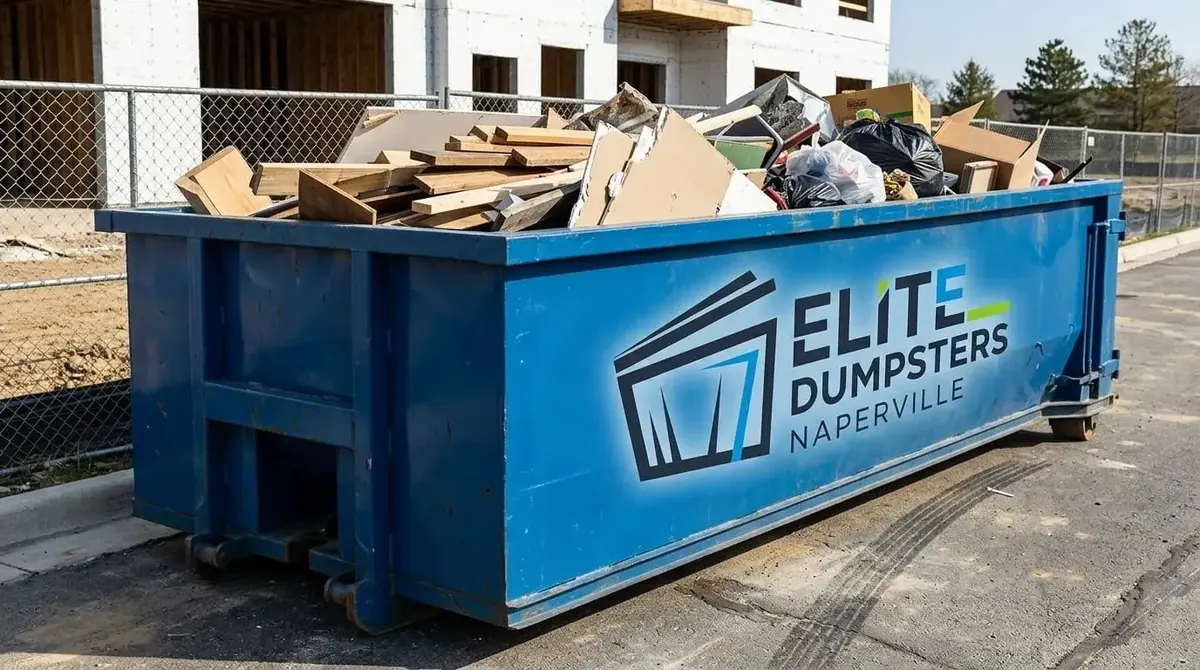
There is a height limit as well. Debris must stay level with the top rim: an overfilled dumpster cannot be safely transported, so it waits until the top comes off.
Measure the drop spot
Allow about 22 feet of length for a 20, 30 or 40 yard box, room for the truck to line up, and clear space overhead for the lift — watch for low limbs and wires. The 10 yard is compact and easy to place, which makes it the one for tight driveways and smaller lots. If you want extra protection for the driveway, lay plywood or boards under the wheels, or ask us to.
Keep it on private property where you can. We found no City of Naperville permit for a roll-off on your own driveway, but anything on the street, parkway, alley or sidewalk needs a City Right-of-Way permit with about 14 days of review. Some neighbors are stricter: West Chicago wants the dumpster for permitted work on private property at least 5 feet from the property line, and North Aurora bans containers in the right-of-way outright. The town-by-town permit guide covers all 17 places we serve.
Why the Groot cart will not do it
People sometimes try to feed a remodel through weekly pickup. In Naperville, the City's contractor Groot takes construction debris only in small amounts: two rolls of carpet a week, no bigger than 4 by 2 feet and 60 pounds each, and drywall or paneling in no more than two 32-gallon cans, two bundles, or one of each per week. Bulk items are two a week. A kitchen gut-out is weeks of that.
The neighbors are similar. Wheaton's hauler LRS charges $17.00 a cubic yard plus a $24.00 pickup charge for do-it-yourself construction debris. In Bolingbrook, Flood Brothers takes small DIY amounts at $15.75 a yard with a 2-yard minimum. Winfield's spring clean-up asks residents to put out no more than 4 cubic yards. Bolingbrook's code goes further on building sites: § 42-6(b) wants construction rubbish stored in a container of at least 15 cubic yards, emptied within 24 hours of being full. A dumpster is for the pile that is bigger, heavier or sooner than the cart allows.
Five ways to get the size right
- Choose the correct size. Too small means another pickup; too large means paying for unused capacity.
- Plan the project. Have debris ready before delivery so you use the whole rental period.
- Avoid overloading. Load evenly and keep it level with the rim.
- Separate recyclable materials. Metal, yard waste and some construction debris can often be recycled — and yard waste cannot go to an Illinois landfill at all (see the landfill ban).
- Call early. Same-day delivery is often possible when you call early in the day; booking ahead holds your size in busy weeks.
And if the job mixes a slab, a roof and a kitchen, say so — we size for the weight, not the look of the pile. Describe the job on the phone and let us do the arithmetic.